The Questions That Come Up on Every Driveway Estimate
Stained concrete driveways generate more pre-project questions than almost any other service Decorative Concrete of Austin offers. Part of that is because driveways are high-visibility — a driveway is one of the first things people see when they approach a home, and homeowners are understandably cautious about committing to a change they can’t easily undo. Part of it is that there’s a lot of conflicting information online about whether stained concrete holds up in a driveway environment at all.
The short answer is that stained concrete driveways work well in Austin when the right system is specified and installed correctly. The longer answer involves a few specific conditions that need to be right. Here is every question we get asked before a homeowner signs off on a driveway staining project, answered plainly.
Is a Concrete Driveway Actually a Good Candidate for Staining?

Not every driveway is. The first thing we assess is the structural condition of the slab. Staining is surface work — it colors the concrete that’s already there. It doesn’t fix cracks, smooth uneven sections, or address drainage problems. A driveway that needs structural repair should have that work done first; staining a compromised slab produces a colored compromised slab.
Surface contamination is the second assessment point. Driveways accumulate oil and grease from vehicles over years, and these penetrate the concrete surface. Oil contamination blocks stain penetration and produces uneven results — stained zones where the concrete is clean, unstained or differently colored zones where oil is present. We test and treat contaminated areas during prep, but heavily contaminated driveways require more aggressive cleaning and grinding before staining is viable.
Existing coatings or sealers are the third variable. A driveway that has been previously sealed needs the sealer removed — stain cannot penetrate through a coating. Diamond grinding removes most existing sealers and opens the surface for staining. We check for this during the estimate and factor it into the scope.
Acid Stain vs. Water-Based Stain for Driveways
Both systems are used on driveways, but they’re appropriate in different contexts. See our full breakdown of acid stain vs. water-based stain for detail — here’s the driveway-specific summary:
Acid stain
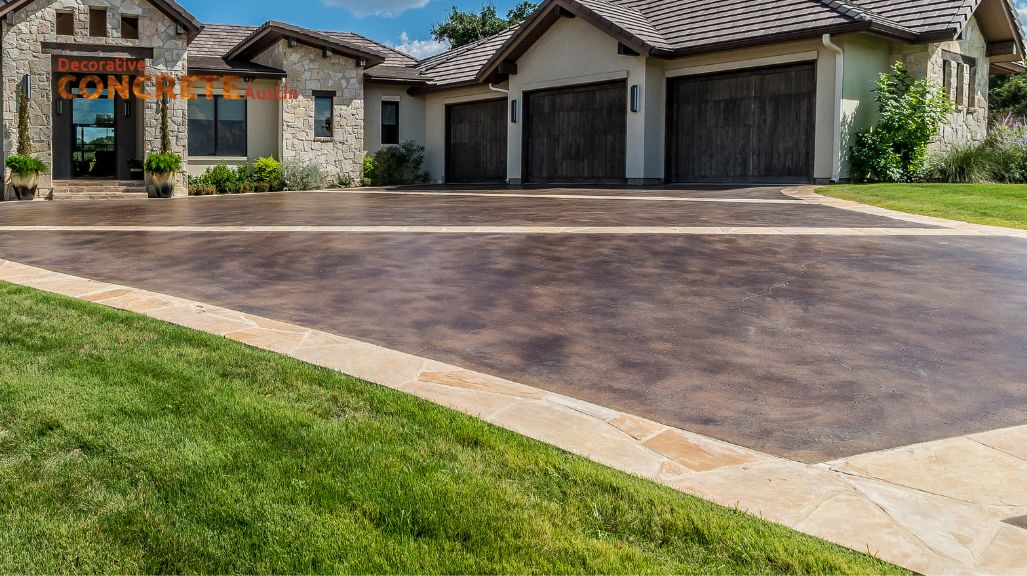
Produces the organic, variegated earth-tone look most people associate with stained concrete. The color is chemically bonded to the slab and genuinely permanent. The limitation is color range — warm ambers, browns, terracottas, and some cooler greens and blues depending on the slab’s mineral composition. You’re working with what the chemistry produces, not a paint color chart.
For driveways, acid stain is a strong choice when the homeowner wants a natural, stone-like appearance that reads as an upgrade without looking synthetic. It’s particularly well-suited to slabs in West Austin and Lakeway Hill Country properties where the earth-tone palette complements the architecture and landscape.
Water-based stain
More predictable color, wider palette, and more consistent results across variable slab conditions. Better choice when the design direction requires a specific color, when the slab has more surface variation that would produce unpredictable acid stain results, or when a more uniform finish is the goal. Water-based stain on a driveway in Cedar Park or Round Rock where the home has a more contemporary aesthetic is often a better fit than the organic look of acid stain.
What Sealer Is Used — and Why It Matters More Than the Stain
The stain choice is visible. The sealer choice is what determines how long the finish holds up. On a driveway specifically, sealer selection is critical because the surface faces stresses that interior floors and even patios don’t:
- Vehicle tire traffic — including the hot tire pickup risk in Austin’s summer heat
- Oil and fluid drips from vehicles that need to be wipeable without penetrating to the stain
- Full sun UV exposure for most of the year
- Rain and water sheeting across the surface
We use penetrating sealers with UV stabilizers and anti-slip aggregate on driveways. Film-forming sealers — the kind that sit on top of the concrete and create a glossy surface — are not appropriate for driveways in Austin. They’re more prone to hot tire pickup, more vulnerable to UV degradation, and more likely to show wear patterns from tire tracks. Penetrating sealers don’t create a film to peel; they protect from within the concrete surface.
The resealing interval on a driveway in Austin is typically every two to three years. On north-facing driveways with significant shade coverage, it can extend to three to four years. On full-sun south-facing surfaces, closer to two years is realistic. We give every customer a written maintenance schedule at project completion.
What the Installation Process Looks Like
A typical driveway staining project in Austin, Pflugerville, or Georgetown runs two to three days:
Day 1: Surface prep
Power wash to remove loose debris, then diamond grinding to open the concrete surface profile and remove any existing sealer, paint, or surface contamination. Oil spots get targeted treatment with degreaser and enzyme cleaner, then re-grind if needed. Cracks are filled with a semi-rigid polyurea filler. The driveway needs to dry completely after grinding before stain application — minimum 24 hours, longer if humidity is high.
Day 2: Staining
For acid stain: the stain is applied, allowed to react for the specified dwell time, then carefully neutralized with a baking soda and water solution to stop the reaction. The neutralization residue is rinsed and the surface is allowed to dry completely. For water-based stain: application is more controlled, typically two to three passes to build color depth, with drying time between coats.
Day 2–3: Sealing
Once the stain is fully dry and the surface reads as the target color and texture, the penetrating sealer is applied in two coats. Anti-slip aggregate is broadcast into the first coat while wet. The second coat locks it in. The driveway can be walked on within 24 hours. Vehicle traffic should be kept off for 72 hours after the final sealer coat to allow full cure — particularly important in summer heat where cure dynamics are faster but surface hardness needs time to develop.
What Can Go Wrong — and How to Avoid It

Knowing the failure modes makes it easier to evaluate any contractor you’re considering:
- Skipping diamond grinding and using acid etching only: acid etching does not produce the surface profile needed for reliable stain penetration. Any contractor who quotes driveway staining without mentioning diamond grinding is cutting prep corners.
- Applying stain over residual oil contamination: produces permanent blotchy results. Oil treatment and verification must happen before stain goes down.
- Using a film-forming sealer on a driveway: will peel within one to two Austin summers, especially in high-sun exposure. Penetrating sealer is the correct specification.
- Not including anti-slip additive: a smooth-sealed concrete driveway is a slip hazard when wet. Anti-slip grit in the sealer is non-negotiable on a driveway.
- Staining a structurally compromised slab: staining won’t fix an active crack or a settled section. The color makes the problem more visible, not less.
Is Staining Right for Your Driveway?
If your driveway is structurally sound, not heavily contaminated, and you want a finish that looks significantly better than plain gray concrete without the cost of replacement or pavers — stained concrete is worth a serious look. It’s one of the most cost-effective upgrades available for an existing concrete surface.
We serve driveways throughout North Austin, South Austin, and the surrounding metro. Our stained concrete driveway service page has examples of finished work. Or contact us for a free estimate — we’ll look at the slab, tell you what prep it needs, and give you a straight recommendation on whether staining is the right call.
Areas We Serve
Decorative Concrete of Austin serves homeowners and businesses throughout Central Texas, including Austin, West Austin, North Austin, South Austin, Cedar Park, Round Rock, Lakeway, and Georgetown. Contact us to confirm availability in your area.