What Austin Does to Pool Decks
Pool decks in Austin age faster than most other outdoor concrete surfaces. The combination of factors is specific to this environment: intense UV from May through October, surface temperatures on exposed concrete that regularly exceed 150°F in full sun, pool chemicals that splash and migrate to the deck edge, the wet-to-dry cycling from pool water and afternoon storms, and the freeze-thaw stress from Austin’s occasional hard freezes.
The result is that pool decks that are fifteen years old in Austin often look like they’re twenty-five. Faded color, worn texture, surface scaling, cracks at control joints, and delaminated coating edges are normal at that age — and all of them are addressable with the right resurfacing system.
At Decorative Concrete of Austin – Polished & Stained Concrete, we resurface pool decks throughout the Austin metro. Here’s what the options look like, how they perform in this specific climate, and what the process actually involves from first call to finished surface.
First Question: Is the Deck a Resurfacing Candidate?

Not every pool deck qualifies for overlay resurfacing. The same structural assessment that applies to patios applies here — see our full guide on what’s fixable on cracked concrete for the detailed criteria. The short version for pool decks:
- Hairline cracks, surface scaling, and worn texture: resurfaceable.
- Active cracking with vertical displacement — one section higher than the other: needs structural attention first.
- Settled or heaved sections: requires lifting or replacement before resurfacing.
- Severe spalling that exposes aggregate throughout: depends on depth — we grind and assess.
- Delaminating existing coating: remove completely before applying new system.
The pool deck is also where we pay particular attention to drainage. An overlay that raises the deck surface height even slightly can affect how water drains toward or away from the pool edge. We account for this in product selection and thickness.
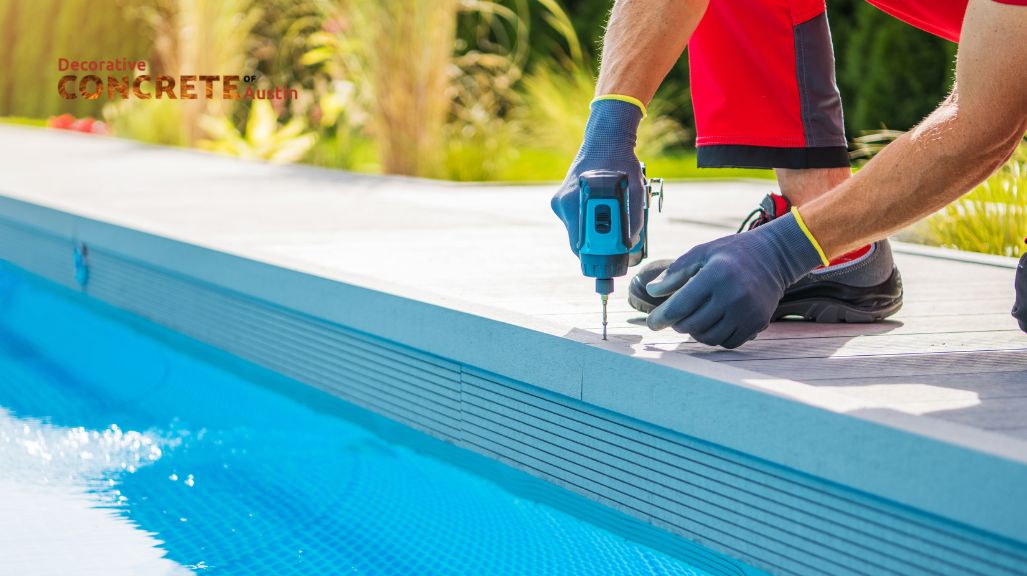
Resurfacing Options for Austin Pool Decks
Kool Deck / Acrylic Spray Texture
The original and still most common pool deck finish in Austin. A spray-applied acrylic overlay available in various texture densities, typically applied in a light tan or sand color to reduce surface temperature. A standard Kool Deck surface can be 15–25°F cooler than bare gray concrete in full sun — meaningful when you’re walking barefoot from the pool to a lounge chair in July.
This system works on existing Kool Deck that’s worn, faded, or peeling — the old surface is ground or power-washed back to sound material and a fresh system is applied. Texture and color can be refreshed to like-new condition. Lifespan with regular resealing is 8–12 years in Austin conditions.
Stamped Overlay
A polymer-modified overlay stamped to look like stone, slate, or travertine. More expensive than acrylic spray but dramatically more design-forward. Popular for Lakeway and West Austin properties where outdoor living areas are a significant part of the home’s value proposition. Applied at 1/4 inch or more, it has better crack tolerance than thin spray systems and handles foot traffic and furniture movement well.
Color and texture options are wide. Integral color is more UV-stable than topical stain on overlay. The surface is sealed with a UV-stable penetrating sealer; anti-slip additive is specified at the pool edge.
Spray Knockdown Texture
Similar to Kool Deck but using a cementitious rather than acrylic base material. Applied by spraying, then knocking down the peaks with a trowel while wet to create a semi-smooth texture. Cost-effective, durable, and handles Austin’s climate well. Available in multiple color options. Good choice for Cedar Park and Round Rock pool decks where budget is a priority and the existing deck is in reasonably sound condition.
Exposed Aggregate Resurfacing
Seeded aggregate overlay — a thin cementitious overlay with decorative aggregate broadcast into the surface while wet. Creates a textured, slip-resistant surface with significant visual impact. The aggregate options range from standard river pebble to glass bead and quartz blends. Durable, UV-stable, and very slip-resistant. More labor-intensive than spray systems, which is reflected in the cost.
What We Don’t Recommend for Pool Decks
Standard epoxy coating: UV degradation in Austin’s sun causes yellowing and peeling within two to three seasons on exposed surfaces. Occasionally appropriate under covered sections of a pool deck, but not for exposed areas.
Smooth microtopping: The slip hazard around a pool with a polished or smooth surface is significant. Any smooth finish system requires substantial anti-slip additive, which typically defeats the aesthetic purpose of a microtopping. Textured systems are more appropriate.
What the Resurfacing Process Looks Like
Here’s a typical pool deck resurfacing project from start to finish:
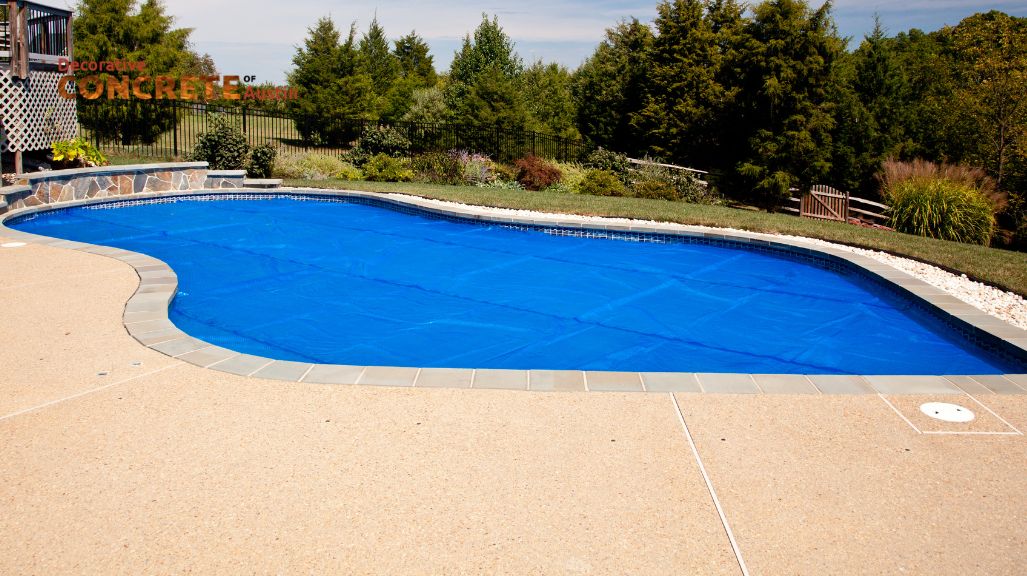
Day 1: Assessment and surface prep
We walk the deck, document condition, test for delamination by sounding the surface, check drainage, and identify any cracks or structural issues that need treatment before overlay. Then surface prep begins: grinding or shot blasting to remove existing coatings and open the concrete surface profile. Cracks are routed and filled. Pool edge, coping, and any drains are masked.
Day 1–2: Crack and joint treatment
Hairline cracks filled with semi-rigid polyurea. Wider cracks routed, cleaned, and filled. Control joints treated based on whether they’re intended to move or be bonded over. This step takes as long as it takes — cutting corners on crack prep is how you get reflective cracking through a new overlay within one season.
Day 2–3: Overlay application
Primer applied first, then the overlay system in the specified number of coats. For spray systems, this is typically done in one to two sessions. For stamped overlays, the base coat, color coat, and stamp work happen in sequence across multiple days. Product cure time between coats is not negotiable — in Austin’s summer heat, this means early-morning starts before the surface temperature spikes.
Day 3–4: Sealing
Final sealer application after the overlay has cured to manufacturer specification. Anti-slip additive is broadcast into the first sealer coat at the pool edge and step areas. A second sealer coat is applied after the first has dried. The deck is ready for foot traffic in 24 hours and pool use in 48–72 hours.
The full process for a standard residential pool deck in Austin, Georgetown, or North Austin typically runs three to four days, weather dependent. We work around Austin’s afternoon thunderstorm season by staging application for morning completion.
Maintenance After Resurfacing
 A resurfaced pool deck in Austin needs resealing every one to two years — faster than interior surfaces because of UV, pool chemical exposure, and wet-dry cycling. The water bead test (pour water on the surface — if it absorbs rather than beads, reseal) is the simplest indicator. pH-neutral cleaners only; avoid muriatic acid, bleach, or any acid-based pool chemicals that splash onto the deck surface.
See our complete concrete patio maintenance guide for the full seasonal maintenance routine — most of it applies directly to pool decks as well.
Ready to talk about your pool deck? Get in touch for a free estimate. We’ll assess the deck condition, recommend the right system for your budget and goals, and give you a straight answer on timeline and cost.
Areas We Serve
Decorative Concrete of Austin – Polished & Stained Concrete serves homeowners and businesses throughout Central Texas, including Austin, Lakeway, West Austin, Cedar Park, Round Rock, Georgetown, North Austin, and Pflugerville. Contact us to confirm availability in your area.