Decorative Concrete of Austin – Polished & Stained Concrete has been installing commercial concrete flooring across Central Texas since 2012. The Austin commercial market spans a wide range of use cases: restaurants, retail shops, office spaces, medical facilities, light industrial warehouses, and mixed-use developments. Each environment places different demands on a floor, and the system that performs well in a boutique retail space is not the same system that belongs in a commercial kitchen or a distribution warehouse.
This post compares the three main commercial concrete flooring systems we install in Austin, what each one is suited for, and what the selection process looks like for a commercial project.
Why the Austin Commercial Market Has Specific Needs

Commercial concrete flooring in Austin faces a combination of factors that influence system selection. The city’s growth has driven a significant volume of new commercial construction and renovation projects, particularly in restaurant, hospitality, and office sectors. Many of those projects involve converting older industrial or retail spaces where the existing concrete slab has seen years of varied use and may have contamination, mechanical damage, or prior coatings that affect what can be applied on top.
Austin’s commercial construction season runs year-round, which means temperature and humidity during installation are variables that change significantly from a January office renovation to a July restaurant buildout. Coating systems cure differently across that temperature range, and the application process needs to account for those conditions.
The business disruption cost of a flooring project also drives decisions differently than in residential settings. A restaurant or retail space that is closed for flooring work is losing revenue. Project timelines, cure times, and re-occupancy schedules are part of the planning conversation on every commercial project.
Polished Concrete for Commercial Spaces
Polished concrete is one of the most widely used commercial flooring systems in Austin because it provides a professional, durable surface with relatively straightforward long-term maintenance. Our polished concrete services page covers the residential side. Commercial applications follow the same process but at scale and with specifications calibrated for higher traffic volumes.
The advantages of polished concrete in commercial settings are well established. The surface is extremely durable because it is the slab itself, mechanically hardened through diamond grinding and densification rather than a coating applied on top. It reflects light, which reduces the lighting load in large open floor plate environments. It is easy to clean with standard commercial cleaning equipment. And it does not need to be replaced or recoated on the same cycle that coating systems require.
Commercial kitchens require specific consideration. Polished concrete can be used in restaurant dining and front-of-house areas with appropriate sealer specification. Back-of-house kitchen areas that see cooking grease, cleaning chemicals, and regular water exposure require a different finish level and sealer formulation than a front-of-house dining floor. Slip resistance is specified by finish level and measured against OSHA and ANSI standards for commercial kitchen environments. We specify these differently and do not apply a single system across both zones.
Polished concrete is also popular in Austin retail environments. The floor reflects merchandise lighting effectively, holds up to shopping cart and foot traffic, and provides a design-neutral surface that works with a wide range of interior styles. Our work in Austin restaurants and retail shows examples of commercial polished applications across different business types.
Epoxy and Polyaspartic Coatings for Commercial Floors
Commercial epoxy and polyaspartic coating systems are installed where chemical resistance, color customization, and a non-porous surface are priorities. Our epoxy coatings page covers the available systems. In commercial settings, the specifications are higher than residential: thicker film builds, chemical-resistant topcoats, and in some cases, anti-static or anti-microbial formulations for specialized environments.
For light industrial spaces, warehouses, and manufacturing environments in Austin, high-build epoxy systems with polyaspartic topcoats provide excellent chemical resistance and surface durability. Forklift traffic, pallet jacks, and industrial cleaning equipment all generate wear on a floor coating that exceeds what residential applications experience. The coating thickness and hardness specification for these environments is higher than a residential garage.
For commercial kitchens and food service environments, epoxy systems with NSF-compliant formulations and appropriate chemical resistance for commercial kitchen cleaners are the standard recommendation. The non-porous surface of a properly installed epoxy system is easier to maintain to food safety standards than bare or polished concrete, which is why commercial kitchen floor specifications typically specify a coated system in food preparation areas.
The polyaspartic vs epoxy comparison is relevant in commercial settings as well. As covered in our polyaspartic vs epoxy guide, polyaspartic systems cure faster and handle UV exposure better. In commercial settings where rapid re-occupancy is a priority or where the space has natural light exposure, polyaspartic topcoats are often specified over epoxy base coats to maximize both performance and project speed.
Overlay Systems for Commercial Renovation Projects
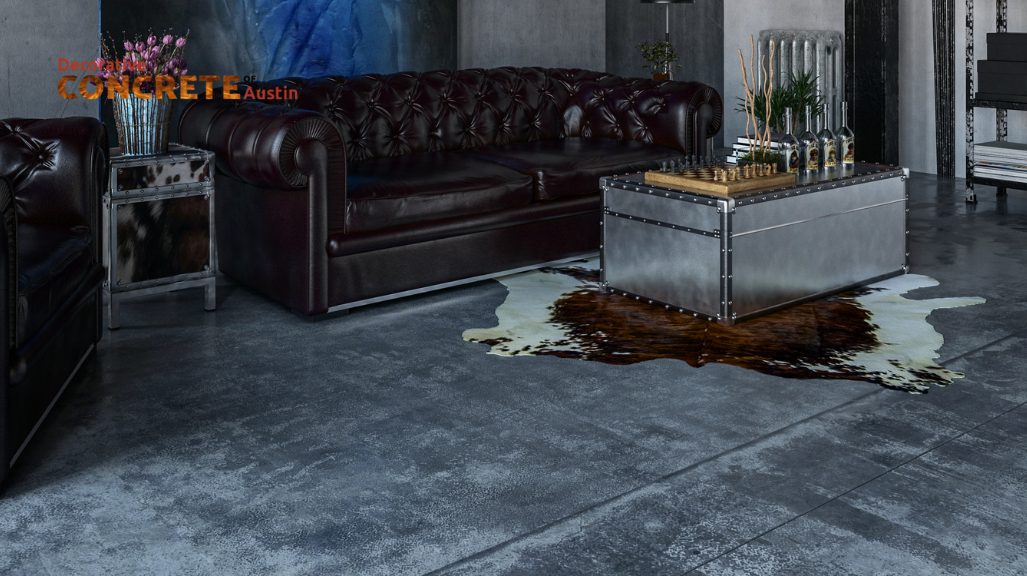
Commercial overlay systems are used extensively in Austin renovation projects where the existing concrete slab is in reasonable condition but the surface appearance needs to change. Converting a former retail space to a restaurant, refreshing the floor of an established office, or updating a hospitality environment without the disruption of a full slab replacement are all situations where concrete overlay systems are used.
Microtopping overlay systems are popular in Austin hospitality and boutique retail environments where a smooth, seamless, contemporary appearance is the design goal. The thin film thickness of a microtopping means minimal height addition to the floor, which is relevant in commercial renovations where door clearances, threshold transitions, and ADA compliance are considerations.
Stampable overlay systems are used in commercial environments where a patterned or textured finish is desired without the disruption of a new pour. A hotel lobby, restaurant entrance, or commercial corridor can receive a stampable overlay that replicates stone or tile patterns at a lower cost and faster timeline than installing the actual materials.
Project Planning for Commercial Clients
Commercial concrete flooring projects require a site assessment that addresses factors beyond what a residential estimate covers. The age and condition of the existing slab, prior use and chemical exposure history, the traffic loads the floor will experience, timeline constraints based on business operations, and any industry-specific compliance requirements all factor into the system specification.
We serve commercial clients in Austin, Round Rock, Pflugerville, Leander, Lakeway, and throughout Central Texas. Decorative Concrete of Austin – Polished & Stained Concrete is fully insured and has completed commercial projects for restaurants, retail, office, and industrial clients since 2012. Contact us to discuss your commercial flooring project and schedule a site assessment.