Why Finish Choice Matters More in Austin Than Most Places

A patio finish that performs well in a mild climate may fail in Austin within a season or two. The combination of intense summer UV, surface temperatures that regularly exceed 140°F on exposed concrete, occasional hard freezes, and heavy rain events creates a stress environment that most coating and finish systems have to be specifically chosen for — not just whatever the contractor defaults to.
At Decorative Concrete of Austin – Polished & Stained Concrete, we’ve installed and maintained patio finishes across the Austin metro for over thirteen years. Some hold up. Some don’t. Here’s an honest account of five finish options, what each one actually looks like after a few Austin summers, and which conditions each is right for.
All of these finishes are available through our patio services. The right one depends on your budget, your aesthetic goals, how much sun the surface takes, and what condition the existing concrete is in.
Finish 1: Stamped Concrete Overlay
What it is
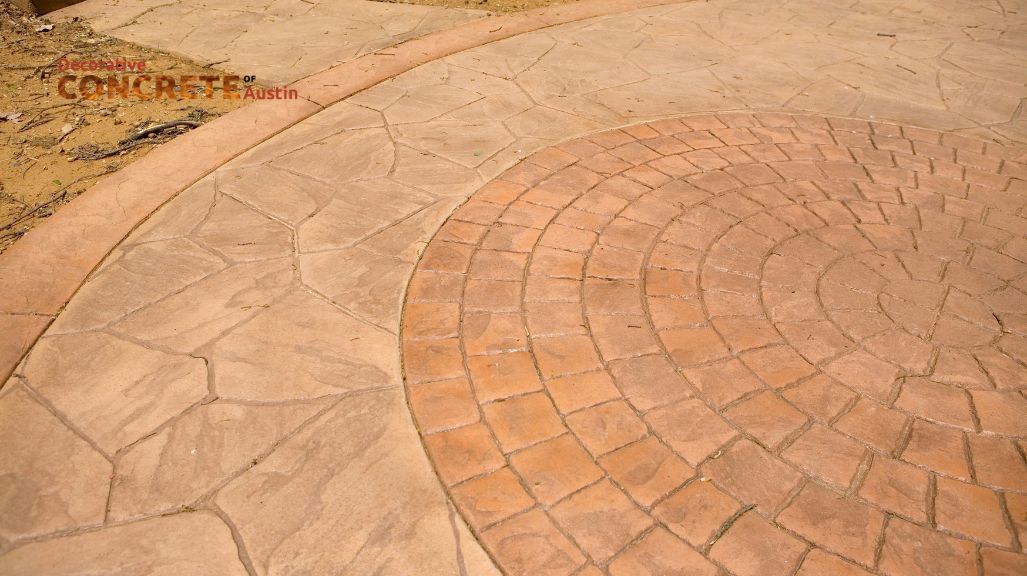
A polymer-modified cementitious overlay applied at 1/4 inch or more, textured with stamps that mimic stone, slate, brick, or tile while workable. Can go over new pours or existing concrete in sound condition.
How it holds up in Austin
This is our most recommended decorative option for exposed Austin patios. The polymer content gives it flexibility to handle thermal movement better than plain concrete. With a UV-stable penetrating sealer, the color holds well — we see good results five to ten years out with normal resealing. The surface texture adds natural slip resistance even when wet, which matters on a patio that gets Austin afternoon thunderstorms.
Best for
Homeowners in West Austin and Lakeway who want the look of stone or slate without the cost and weight of real material. Existing slabs with minor surface issues that would otherwise require overlay anyway.
Limitations
Color can fade faster in full-sun exposure without regular resealing. The surface texture can trap debris and requires more cleaning than a smooth finish. Not appropriate over structurally compromised slabs — see our guide on what’s fixable on a cracked patio.
Finish 2: Stained Concrete
What it is
A chemical or water-based colorant applied to the existing concrete surface, creating a translucent, variegated color that reacts with the concrete’s natural variation. The result is inherently unique — no two stained floors look exactly alike.
How it holds up in Austin
Acid stain chemically bonds with the concrete — it doesn’t sit on top, it becomes part of the surface. That means UV can’t fade the color the way it fades a topical coating. What fails is the sealer over it, not the stain itself. With a quality UV-stable sealer and reapplication every two to three years, stained concrete patios in Austin look as good at year ten as they did at year one. Water-based stains don’t penetrate as deeply and are more vulnerable to UV degradation over time.
Best for
Covered patios, screened porches, and partial-shade areas throughout South Austin and Central Austin. Homeowners who want a natural, organic look rather than a uniform color. Existing concrete in good cosmetic condition that doesn’t need an overlay.
Limitations
Stain amplifies what’s already in the concrete — cracks, patch marks, and aggregate variation all show through. On heavily patched or inconsistent slabs, the result can look uneven. Anti-slip additive in the sealer is essential on outdoor stained surfaces. See our full stained concrete patio page for more detail.
Finish 3: Exposed Aggregate
What it is
A finish achieved by washing or brushing the surface of fresh concrete before it fully sets, exposing the aggregate (gravel, pebbles, or decorative stone) embedded in the mix. Can also be achieved on existing concrete by shot blasting to expose aggregate already present.
How it holds up in Austin
Exposed aggregate is among the most durable outdoor finishes available. There’s no coating to peel, no sealer to fail — the surface is the concrete. In Austin’s climate, it handles UV, heat, and rain without degradation. The textured surface provides excellent slip resistance. It does require periodic sealing to protect the aggregate-cement interface from moisture and staining, but the base material itself is essentially permanent.
Best for
Pool decks, driveways, and patios in full sun exposure in North Austin and Round Rock where durability and slip resistance are the primary concerns. New construction where the finish can be specified in the original pour.
Limitations
The texture can be rough underfoot depending on aggregate size — not ideal for barefoot pool surrounds if large aggregate is used. Less design flexibility than stamped or stained options. Harder to achieve on existing slabs without significant surface grinding.
Finish 4: Spray Texture / Knockdown
What it is
A thin polymer cement overlay spray-applied to the existing surface, then knocked down with a trowel while wet to create a subtle texture pattern. A common finish for pool decks and patio resurfacing throughout Central Texas.
How it holds up in Austin
Spray texture is a practical, cost-effective finish that handles Austin’s heat and UV reasonably well when properly sealed. It’s thinner than a stampable overlay — typically 1/8 inch or less — so it doesn’t have the same crack-bridging capability. On slabs without significant cracking, it performs reliably. The knockdown texture provides decent slip resistance, though it can wear in high-traffic areas over time.
Best for
Pool decks, utility patios, and budget-conscious resurfacing projects in Cedar Park and Georgetown. Slabs in good structural condition that need a cosmetic refresh.
Limitations
Less aesthetic depth than stained or stamped finishes. Not appropriate for slabs with significant cracking or structural issues — the thin cross-section doesn’t bridge problem areas.
Finish 5: Polyaspartic Topcoat Over Concrete
What it is
A polyaspartic aliphatic coating — related to but different from standard epoxy — applied as a clear or lightly pigmented topcoat over prepared concrete. Polyaspartic cures faster, has superior UV stability compared to epoxy, and handles wider temperature ranges during application.
How it holds up in Austin
For covered outdoor areas — pergolas, covered patios, screened porches — polyaspartic performs well in Austin’s climate. It has far better UV resistance than standard epoxy and won’t yellow the way epoxy does in sun exposure. On fully exposed patios, even polyaspartic will degrade faster than a penetrating sealer on stained or stamped concrete. We primarily use polyaspartic as a topcoat component in our epoxy coating systems for garage floors and covered surfaces, not as a standalone outdoor patio finish.
Best for
Covered outdoor living areas in Downtown Austin condos and urban properties, or covered patios where the coating won’t receive direct UV exposure. Commercial outdoor surfaces with high foot traffic that need a more abrasion-resistant finish than penetrating sealer alone.
Limitations
Not appropriate for fully exposed outdoor surfaces in Austin’s sun. Higher cost than penetrating sealer options. Surface prep requirements are significant — diamond grinding and moisture testing required before application.
Summary: Which Finish for Which Situation

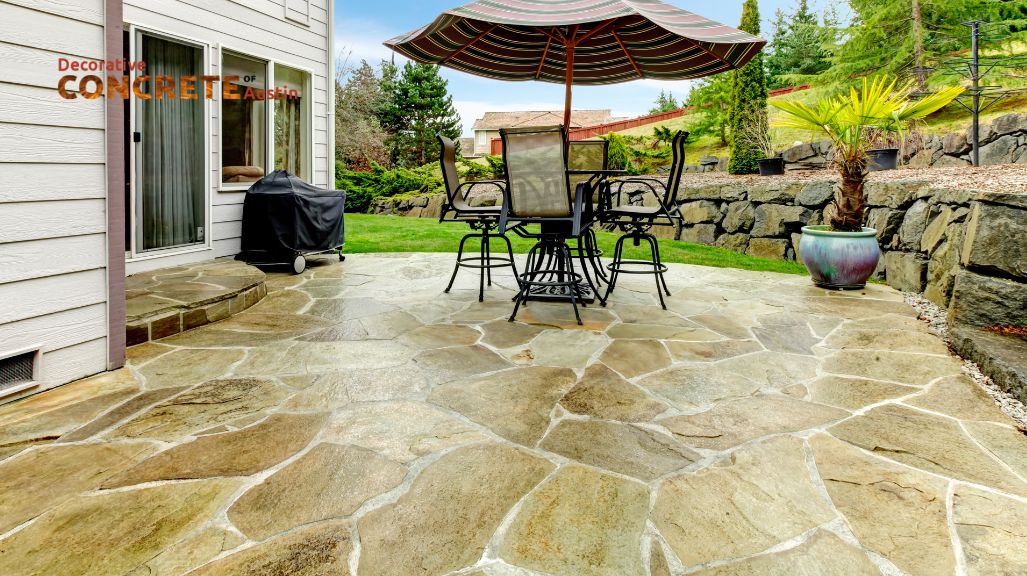
Full sun, exposed patio — stamped overlay or exposed aggregate with UV-stable sealer. These handle direct sun best long-term.
Covered patio or screened porch — stained concrete or polyaspartic topcoat. Either performs well without direct UV degradation.
Pool deck — spray texture knockdown or exposed aggregate. Both provide slip resistance and handle wet conditions.
Budget resurfacing — spray texture knockdown on a structurally sound slab. Lowest cost entry point for a finished look.
Maximum design impact — stamped overlay or acid-stained concrete with custom color. These give the most visual differentiation from plain concrete.
If you’re not sure which category your project falls into, get in touch for a free estimate. We’ll look at the slab, the sun exposure, and your goals, and tell you which option makes sense before any proposal is written.
Areas We Serve
Decorative Concrete of Austin – Polished & Stained Concrete serves homeowners and businesses throughout Central Texas, including Austin, West Austin, South Austin, North Austin, Lakeway, Cedar Park, Round Rock, and Georgetown. Contact us to confirm availability in your area.