Most people who are considering polished concrete have seen it somewhere and liked what they saw. What they usually do not have a clear picture of is how that result gets produced, which matters because the process determines the outcome almost entirely. At Decorative Concrete of Austin, the single most common source of dissatisfaction on polished concrete jobs we are called to fix is not a product failure. It is a process failure, and specifically a prep failure, from a previous installation.
Understanding the process makes it easier to evaluate what you are being quoted, ask the right questions, and know what to expect at each stage of the job.
The Starting Point: Slab Assessment

Before any equipment comes out, the slab needs to be assessed. This is not a courtesy step. It is the step that determines every subsequent decision: which diamond tooling to start with, how many grinding passes are needed before densification, what aggregate exposure level is achievable, and whether any prep work is required before the polishing sequence begins.
The key variables we assess are concrete hardness, surface condition, the presence of coatings or sealers, moisture levels, and the presence of cracks or surface defects that need to be addressed before polishing starts. A Mohs hardness test gives us a baseline for the concrete. Surface condition indicates whether we need a coarser opening pass to remove contamination or a damaged surface layer before we can begin the actual polishing sequence.
Skipping or rushing this assessment is where most polished concrete problems start. A contractor who shows up and immediately begins grinding without a proper evaluation of the slab is guessing at the correct starting point rather than knowing it. On a hard slab, starting too aggressively removes more material than intended and can expose aggregate at a depth the client did not want. On a soft slab, starting too fine produces a surface that burnishes without actually refining, creating the appearance of polish without the density underneath.
Surface Preparation
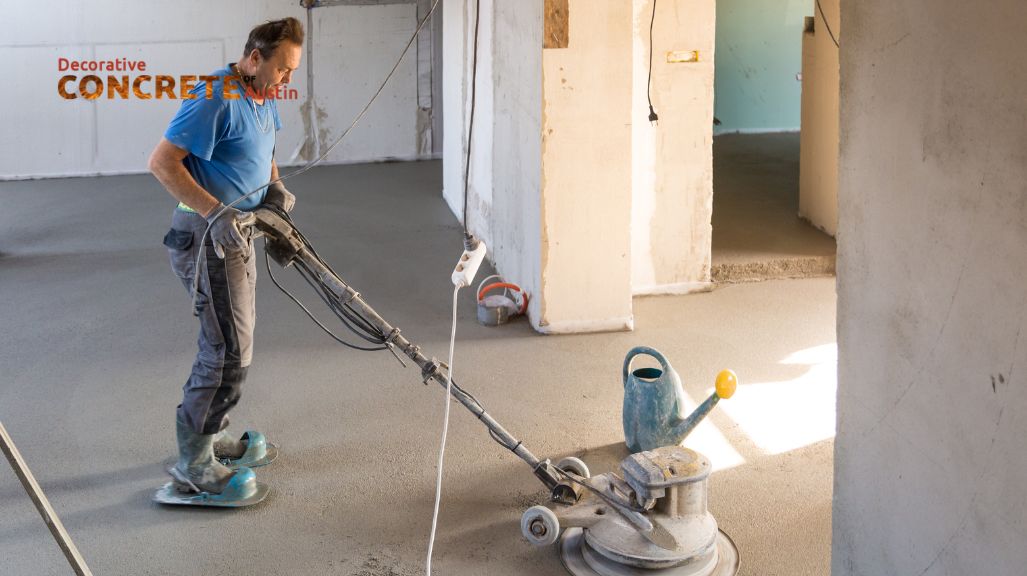
If the slab has an existing coating, sealer, adhesive residue, or paint, it must be removed before polishing can begin. These materials interfere with the grinding sequence and prevent the diamond tooling from working on the actual concrete surface. Depending on what is present, removal may involve coarse diamond grinding, chemical strippers, or both.
Cracks and surface defects are addressed at this stage as well. Stable cracks, meaning cracks that are not actively moving due to foundation settlement or thermal cycling, are ground out slightly to create a clean void, then filled with a semi-rigid epoxy or polyurea filler. The fill material is chosen for color compatibility with the concrete and for hardness appropriate to the grinding sequence that follows. If the filler is too hard, it polishes differently from the surrounding concrete. If it is too soft, it crumbles during the grinding passes.
In South Austin and Central Austin homes with slabs dating to the mid-twentieth century, this prep stage often involves more work than on a newer slab. Older concrete was poured to different specifications and has had more time to accumulate surface contamination, previous sealer applications, and minor cracking from decades of thermal cycling. This is not a problem that prevents polishing. It is a variable that requires adequate time and tooling to address correctly.
The Grinding Sequence
Polished concrete is produced through a sequence of grinding passes using progressively finer diamond tooling. Each pass removes the scratch pattern left by the previous pass and refines the surface to a higher level. The number of passes in the sequence depends on the slab’s starting condition and the specified finish level. A typical sequence runs from a coarse opening grit to a finishing grit over four to eight passes.
The opening passes use metal-bonded diamond segments, which are aggressive enough to cut through the surface layer and begin the leveling and refining process. These passes are where the most material is removed and where the floor’s surface character becomes apparent. Aggregate exposure level is determined here: a cream polish stays in the top layer of the concrete and shows a fine-textured surface with minimal aggregate visible; a salt-and-pepper finish exposes the fine aggregate in the concrete; a full aggregate or feature aggregate finish cuts deeper to expose the larger stones in the mix.
As the sequence progresses, the tooling transitions from metal-bonded segments to resin-bonded pads, which are finer and produce a smoother, more refined scratch pattern. The surface becomes progressively more reflective with each pass. Between the coarser and finer stages, a densifier is applied to the floor.
Densification: The Step That Makes Polished Concrete Durable
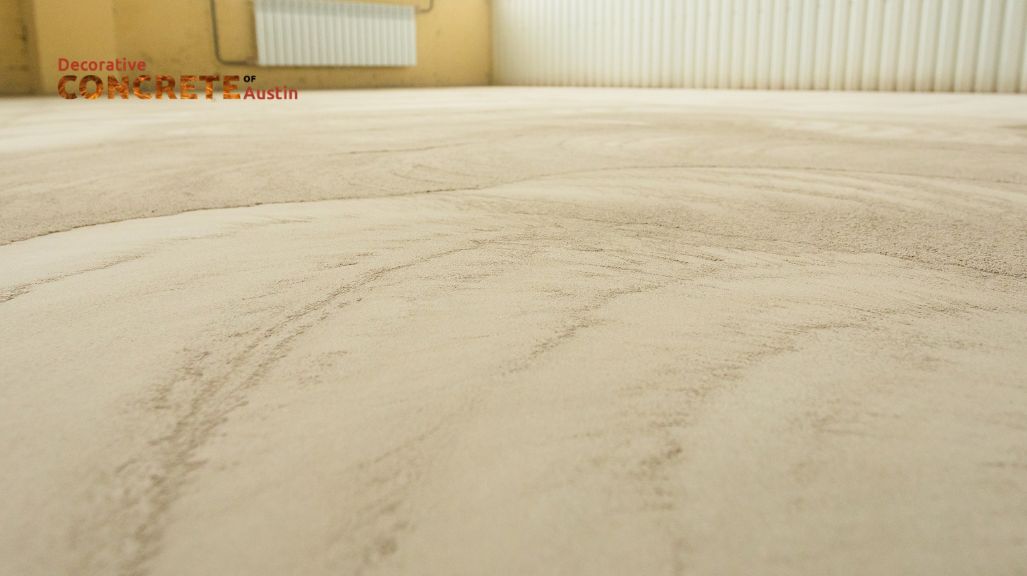
Densification is the chemical step in the polished concrete process, and it is one of the elements that separates a properly executed polished floor from a floor that simply looks polished on the day it is installed but softens and dusts over time.
A liquid densifier, typically silicate-based, is applied to the concrete surface at the appropriate point in the grinding sequence. The densifier penetrates the surface and reacts with the calcium hydroxide in the concrete to produce calcium silicate hydrate, which fills the capillary pores and creates a harder, denser surface. The result is concrete that is significantly more abrasion-resistant, less permeable to liquids, and capable of achieving and maintaining a higher level of polish than untreated concrete.
The timing of densifier application matters. Applied too early in the sequence, it can cause loading in the diamond tooling. Applied too late, after the surface has been fully closed, it cannot penetrate adequately. Getting this right requires experience with the specific products and the specific slab chemistry, which is another reason polished concrete is not a job that benefits from a lowest-bid approach.
The Finishing Sequence

After densification, the grinding sequence continues with resin-bonded diamond pads at increasingly finer grits. The final grit level determines the sheen of the finished floor. Work in the 400 to 800 grit range produces a semi-gloss finish appropriate for most commercial and residential applications. Work at 1500 or 3000 grit produces a high-gloss, mirror-like result that maximizes light reflectivity.
For downtown Austin commercial spaces, restaurants, and retail environments, a 400- to 800-grit finish is typically the right specification. High enough gloss to look refined and professional, but practical enough not to show every footprint and watermark. Residential interiors in West Austin and North Austin homes often go to higher sheen levels because the traffic patterns are lighter and the design intent is more explicitly decorative.
A concrete guard or stain protector is applied at the end of the sequence. This is a penetrating treatment rather than a topcoat sealer. It does not build a film on the surface, it does not change the sheen level, and it does not require stripping and reapplication on a regular cycle. It fills any remaining micro-pores on the surface to reduce the risk of staining and is reapplied periodically as part of routine maintenance.
What the Timeline Looks Like
A well-executed, polished concrete project on a residential floor in the 500- to 1,000-square-foot range typically runs for one to two days. Larger commercial spaces, spaces with significant prep requirements, or projects with elaborate decorative elements take longer. We give project-specific timelines after the site assessment because the prep stage is the most variable part of the job and cannot be accurately estimated without seeing the slab.
The floor is ready for foot traffic within 24 hours of the final guard application curing. We ask clients to hold off on heavy furniture replacement and wet mopping for 48 to 72 hours to allow the penetrating treatments to cure fully.
If you are considering polished concrete for a residential or commercial space in Austin or the surrounding area, the right starting point is a site assessment. We look at the slab, discuss the finish level and aggregate exposure, and give you a realistic picture of what the process involves for your specific floor. Schedule a free estimate to get started.